
The 2026 Semiconductor Landscape: Defect Rates and Counterfeit IC Threats
In the 2026 semiconductor market, utilizing unauthorized component sources causes PCBA defect rates to surge beyond 12%, while a 100% traceable BOM system maintains production yields above 99.8%. Transparent component sourcing bridges procurement and manufacturing by validating every silicon wafer, passive reel, and active integrated circuit (IC) before surface mounting. Counterfeit electronics have evolved beyond primitive ink-jet re-marking. Gray market operators now employ precision laser blacktopping, salvaged die repackaging, and unverified silicon cloned during unauthorized ghost shifts.Counterfeit Electronic Component: An unauthorized copy, imitation, substitute, or modified part knowingly misrepresented as a specified genuine part from an Original Component Manufacturer (OCM), violating SAE AS6081 and SAE AS6171 specifications.
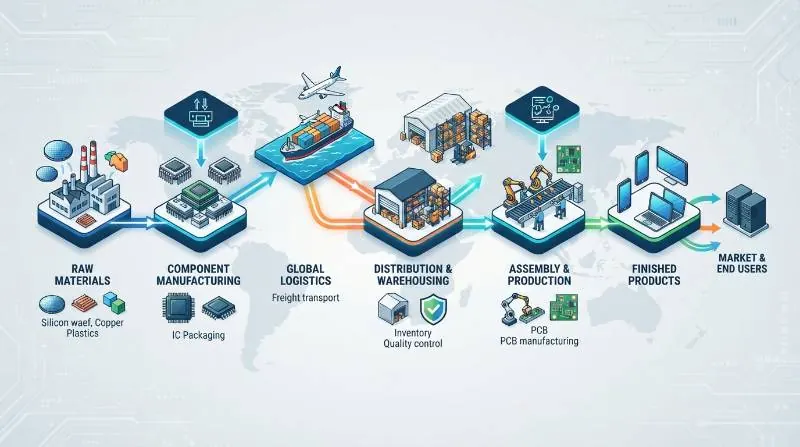
Transparent BOM Pricing and Open-Book Procurement Architecture
True supply chain transparency eliminates hidden markups through direct API synchronization with authorized distributor networks. Direct digital links ensure real-time factory floor pricing from franchised distributors, preventing line-item inflation. Our direct procurement APIs integrate with vetted franchised supply chains, including Digi-Key, Mouser Electronics, Arrow Electronics, and Element14 / Farnell. Every bill of materials line item maps directly to a distributor part number (DPN) and verified manufacturer part number (MPN).Standardized Feeder Scrap & Attrition Rules
High-speed surface-mount technology (SMT) feeders require nominal component overhead to prevent line starvation. Unethical electronics manufacturing services (EMS) providers mask profits inside inflated attrition rates. Transparent manufacturing enforces clear scrap formulas based on packaging geometry:- 0201 & 0402 Chip Passives: Calculated at 3% to 5% attrition (or nominal minimum reel leader padding).
- 0603 & 0805 Passives: Set to a 1% to 2% fixed feeder setup scrap ceiling.
- Fine-Pitch QFP, BGA, and CSP ICs: Fixed at 0% scrap allowance. High-value silicon is handled in matched trays or cut tape with continuous vacuum tracking.
The Visianda 4-Stage IQC & Counterfeit Defense Protocol™
To eliminate component risk from precision SMT assembly solutions, Visianda EMS applies a rigorous four-phase incoming quality control (IQC) framework compliant with IPC and aerospace counterfeit prevention standards.
Stage 1: Packaging Integrity & Optical Coplanarity
Technicians inspect moisture barrier bags (MBB), humidity indicator cards (HIC), and manufacturer anti-static packaging. High-magnification optical microscopy validates lead coplanarity, tinning uniformity, and signs of mechanical refurbishing or blacktopping.Stage 2: High-Resolution 3D X-Ray Analysis
Non-destructive X-ray inspection evaluates internal silicon structure without breaking the package mold. We inspect internal lead frame geometry, wire-bond integrity, and substrate voiding against verified OCM golden samples to catch empty dummy packages and incorrect dies.Stage 3: Chemical Decapsulation & Die Topology Verification
When authenticating unsealed or high-risk broker inventory, automated nitric and sulfuric acid decapsulation dissolves the outer epoxy resin. Engineers verify original die manufacturer markings, mask copyright years, revision identifiers, and metal layer design under high magnification.Stage 4: Solderability & Curve Trace Testing
Sample lots undergo thermal solderability testing in accordance with IPC-J-STD-002 to prevent wetting failures on the SMT line. Pin-to-pin V/I curve trace analysis verifies basic pin parasitics and internal protection diodes before reels move to manufacturing.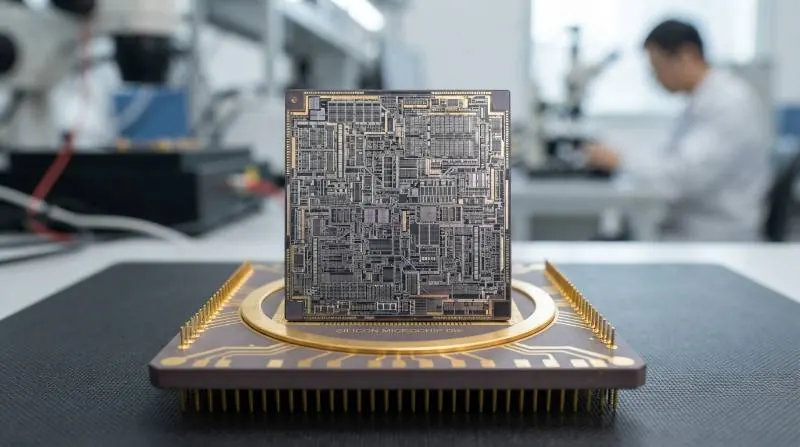
Strategic Component Lifecycle & Engineering Change Notice (ECN) Workflows
Semiconductor obsolescence requires systematic lifecycle management. Component notices for End-of-Life (EOL), Product Change Notifications (PCN), and Not Recommended for New Designs (NRND) must be flagged early during BOM scrubbing. We enforce a strict Zero-Unauthorized-Substitution Policy. If a critical microcontroller or PMIC experiences sudden factory allocation shortages, our engineering team executes a formal Engineering Change Notice (ECN) process:- Pin-to-Pin Compatibility: Electrical, thermal, and footprint verification against original board layouts.
- Firmware Impact Analysis: Verification of register sets, memory addresses, and driver dependencies.
- Written Sign-Off: Customer engineering teams receive complete datasheets, compliance certificates, and price differentials for review before placing alternative hardware.
Turnkey vs. Partial Turnkey vs. Consigned Procurement: Risk & Cost Matrix
Selecting the right procurement model directly impacts engineering overhead, production lead time, and counterfeit exposure. Whether you run rapid prototype PCBA services or full production, aligning procurement strategy with supply chain capabilities is vital.| Evaluation Parameter | Full Turnkey PCBA | Partial Turnkey PCBA | Customer Consigned |
|---|---|---|---|
| Counterfeit Liability | Assumed by EMS Provider | Shared Responsibility | Customer Assumes 100% |
| Traceability Level | Full OCM/Distributor CoC | Hybrid Lot Tracking | Limited to Internal Records |
| Procurement Overhead | Zero Internal Overhead | Moderate (Core Silicon Only) | High (Customer Purchases All) |
| SMT Line Setup Speed | Fast (Direct Feeder Loading) | Moderate Sync Needed | Slower (Requires In-House IQC) |
High-Reliability Standards for Medical and Automotive Electronics
Mission-critical industries require rigorous traceability. Manufacturing components for mission-critical medical electronics PCBA requires ISO 13485 compliance, maintaining verifiable lot codes from wafer fabrication through system deployment. Similarly, automotive-grade electronics manufacturing requires strict adherence to IATF 16949 and AEC-Q100 / AEC-Q200 qualified silicon. These components endure extreme thermal cycling, vibration, and mechanical shock without performance degradation.IPC-A-610 Class 3 Mandate: Demands uninterrupted component lot tracking, zero unauthorized substitutions, and documented Certificates of Conformance (CoC) for all active and passive components.
Frequently Asked Questions About Turnkey PCBA Component Sourcing
What is a Certificate of Conformance (CoC) and why is it necessary?
A Certificate of Conformance is an official document from the original component manufacturer or authorized distributor certifying that the delivered component meets all published specifications and originates from a verified manufacturing lot.Does Visianda EMS ever procure parts from non-authorized independent distributors or brokers?
We source 100% of components from authorized franchised distributors by default. If obsolete or allocated components force secondary market sourcing, parts undergo our rigorous 4-Stage Counterfeit Defense Protocol™ (including 3D X-Ray and decapsulation) with full customer sign-off.Can customers supply specific custom microcontrollers while Visianda sources standard passives?
Yes. Our partial turnkey model allows clients to supply custom ASICs, pre-flashed microcontrollers, or proprietary silicon, while our supply chain team procures passives, power ICs, and mechanical hardware at scale.Audit Your BOM with Visianda EMS: Traceability and Quality Assurance
Sourcing transparency is the foundation of high-yield electronics manufacturing. Our engineering and supply chain teams verify BOM health, component availability, and price parity before starting production.Request a Comprehensive BOM Risk & Traceability Audit
Upload your Bill of Materials (BOM) and Gerber files for a free DFM review, lifecycle risk assessment, and open-book component pricing breakdown from our quality engineers.
Download BOM Traceability Sample & Get a Quote