
Turnkey ISO 13485 Medical Device PCB Assembly Services
ISO 13485 medical device PCB assembly turnkey services deliver fully managed electronic manufacturing—from verified raw material procurement and precision SMT placement to multi-stage testing and regulatory documentation. By integrating strict quality management systems with IPC-A-610 Class 3 build standards, medical OEMs ensure total compliance, zero-defect reliability, and comprehensive lot traceability for critical healthcare applications. Medical electronics leave no room for manufacturing ambiguity. A single solder fracture or contaminated surface in a cardiovascular pump, dialysis unit, or surgical robotics platform can lead to catastrophic clinical consequences. At Visianda EMS, our dedicated lines for medical device electronics manufacturing are built to eliminate process drift, secure component provenance, and maintain regulatory compliance throughout the product lifecycle.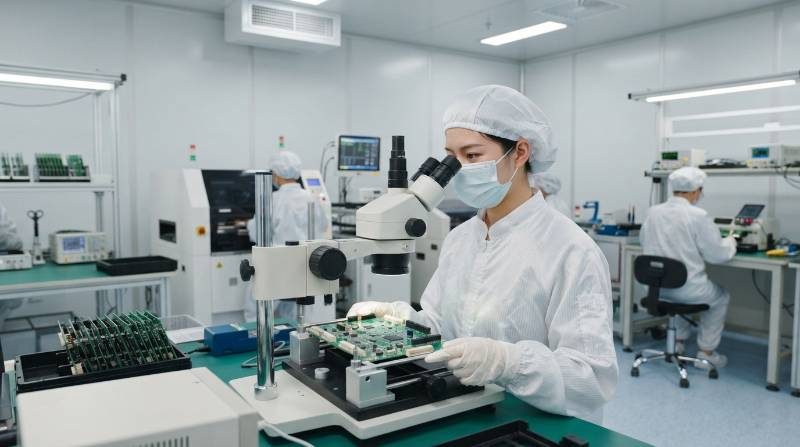
Medical Regulatory Standards & Quality Systems: ISO 13485 and FDA 21 CFR 820
Building Class II and Class III medical hardware requires a quality infrastructure that exceeds typical commercial electronics manufacturing. Compliance starts with a certified Quality Management System (QMS) aligned with both international standards and regional medical device regulations.ISO 13485:2016 specifies requirements for a quality management system where an organization needs to demonstrate its ability to provide medical devices and related services that consistently meet customer and applicable regulatory requirements.
The Operational Distinction: ISO 13485 vs. Standard ISO 9001
While ISO 9001 focuses on general customer satisfaction and continuous improvement, ISO 13485 emphasizes risk management, process validation, cleanroom environmental control, and strict regulatory audit trails. Our comprehensive quality assurance systems enforce these standards at every manufacturing station.- FDA 21 CFR Part 820 Alignment: Adherence to Current Good Manufacturing Practice (cGMP) mandates for medical devices, covering design controls, purchasing controls, and process validation.
- IQ/OQ/PQ Validation Protocols: Installation Qualification (IQ), Operational Qualification (OQ), and Performance Qualification (PQ) for automated reflow ovens, selective solder units, and automated optical inspection systems.
- Closed-Loop CAPA Framework: Corrective and Preventive Action processes integrated into engineering databases to mitigate production anomalies in real time.
Comprehensive Traceability: Device History Records (DHR), UDI, and Lot Tracking
Traceability is non-negotiable in medical EMS. When field anomalies occur, your manufacturing partner must provide complete visibility into the production genealogy of every sub-assembly down to the exact wafer lot or solder paste batch.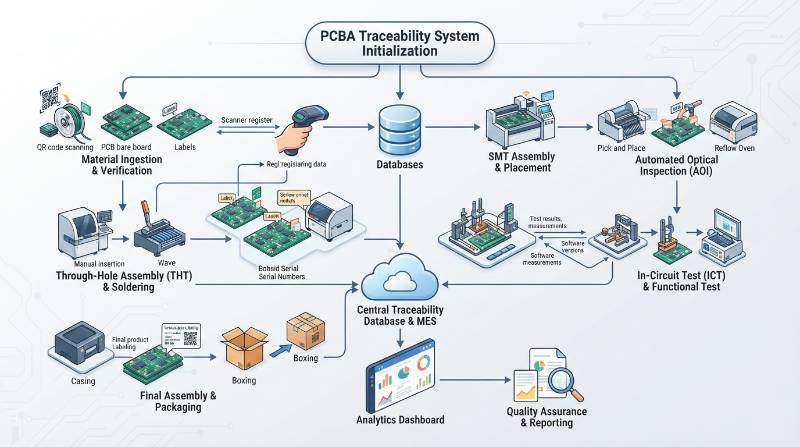
2D DataMatrix Laser Marking and UDI Management
Every medical board processed at Visianda EMS receives a high-contrast, laser-etched 2D DataMatrix barcode before solder paste deposition. This code links directly to our MES (Manufacturing Execution System), creating an immutable production log that meets Unique Device Identification (FDA UDI System) parameters.- Reel-Level Traceability: Component reels, cut tapes, and trays are scanned and tied to individual circuit boards.
- Solder Paste & Chemical Logs: Solder alloy batch numbers, flux types, thaw times, and stencil printing environmental metrics (temperature/humidity) are logged automatically.
- Moisture Sensitive Level (MSL) Tracking: Strict tracking under IPC/JEDEC J-STD-033 standards ensures moisture-sensitive active ICs undergo dry baking when exposure timers exceed limits.
- Automated eDHR Generation: Digital Device History Records compile inspection images, test logs, operator IDs, and Certificates of Conformance into an audit-ready PDF package.
The Visianda MedTrace™ Turnkey Assembly Protocol
In our medical manufacturing operations, standard consumer-grade production workflows fail to catch low-ppm micro-defects. We engineered the Visianda MedTrace™ Protocol to systematically eliminate defect risks before, during, and after physical surface mount assembly.Engineering Insight: Medical devices deployed in vivo or in diagnostic life-support environments experience severe cyclic thermomechanical stress. Our MedTrace™ protocol establishes an automated 5-point verification gate that enforces zero process deviation across every shift.The MedTrace™ framework incorporates five interconnected phases:
- ISO 14971 Risk Integration: pFMEA (Process Failure Mode and Effects Analysis) applied directly to customer schematics and BOM data prior to tooling fabrication.
- Closed-Loop 3D SPI Verification: Solder Paste Inspection cross-checks height, volume, and alignment against stencil parameters, pausing lines if volume deviations exceed ±10%.
- Dual-Vector SMT Alignment: Dual optical centration ensures high-density 01005 passives and ultra-fine-pitch BGAs (down to 0.3mm pitch) achieve ±15µm placement accuracy.
- 3D AXI Void Characterization: 100% automated X-ray inspection for bottom-terminated components, ensuring solder voiding remains below 10% under critical thermal and ground pads.
- Controlled ESD & Cleanroom Packaging: Final wash, ionic cleanliness verification, and vacuum sealing inside Class 8 cleanroom environments to avoid particulate contamination.
High-Precision SMT & Through-Hole Capabilities for Life-Critical Devices
Medical PCBA designs increasingly integrate high processing density into compact, handheld, or implantable form factors. Our turnkey PCB assembly solutions leverage advanced equipment to satisfy demanding IPC-A-610 Class 3 specifications.
| Inspection Parameter | IPC-A-610 Class 2 (Standard) | IPC-A-610 Class 3 (Medical / Life Support) |
|---|---|---|
| Through-Hole Barrel Fill | Minimum 50% vertical fill | Minimum 75% vertical fill required |
| SMT Component Alignment | Side overhang up to 50% pad width | Side overhang max 25% pad width (zero overhang preferred) |
| BGA Solder Void Limits | Voids ≤ 25% total ball area | Voids ≤ 15% (Visianda internal medical target: ≤ 10%) |
| Cleanliness & Flux Residue | Visual non-corrosive residue allowed | Strict ionic limits (< 1.56 µg/cm² NaCl eq.) verified by ROSE testing |
Conformal Coating and Potting for Harsh Environments
Medical electronics frequently face sterilization cycles, bodily fluid contact, or chemical wipe-downs. We offer automated selective conformal coating (acrylics, silicones, polyurethanes, and Parylene) alongside structural epoxy encapsulation to shield sensitive analog circuitry from dielectric breakdown.Medical DFM/DFA Engineering & Upstream Risk Elimination
Early design stage collaboration saves weeks of regulatory rework. Our engineering staff conducts comprehensive medical DFM and DFA engineering reviews on all incoming packages before CAM production releases.- Solder Bridging Mitigation: Calculating precise solder mask dam clearances (down to 0.075mm) between ultra-dense fine-pitch QFNs and micro-BGAs.
- Thermal Profiling Optimization: Multi-channel thermocouple testing models thermal mass variations on multi-layer medical boards (up to 32 layers) to prevent localized overheating.
- Testpoint Strategy & Fixture Accessibility: Ensuring minimum 0.8mm test pad targets across 100% of critical nets to support flying probe and bed-of-nails ICT architectures.
- High-Tg Substrate Reliability: Validating copper weight, dielectric constant stability, and glass transition temperatures (Tg ≥ 170°C, Td ≥ 350°C) to withstand repeated autoclaving.
Medical Supply Chain Integrity: Counterfeit Mitigation & Lifecycle Management
The infiltration of substandard or counterfeit active components into medical equipment creates severe safety risks. Visianda EMS implements an audited supply chain infrastructure aligned with aerospace-grade standards.Authorized Sourcing and AS6171 / AS5553 Compliance
All active microcontrollers, analog front ends, and passive components are sourced directly from original manufacturers or authorized distributors (e.g., Arrow, Avnet, DigiKey, Mouser). For legacy medical programs where components face obsolescence:- Certificates of Conformance (CoC): Mandatory manufacturer CoCs and lot traceability sheets accompany every received shipment.
- Component Authenticity Verification: In-house visual decapsulation, X-ray leadframe inspection, and XRF alloy composition checks based on SAE AS6171 inspection protocols.
- Proactive EOL / PCN Tracking: Early notifications of Product Change Notices (PCN) and End-of-Life (EOL) events prevent unexpected circuit redesigns and costly medical re-certifications.
Multi-Stage Testing and Validation for Medical PCBAs
Inspection processes must deliver clear, actionable data. Visianda EMS utilizes an integrated validation pipeline to ensure assemblies perform reliably under real-world clinical conditions.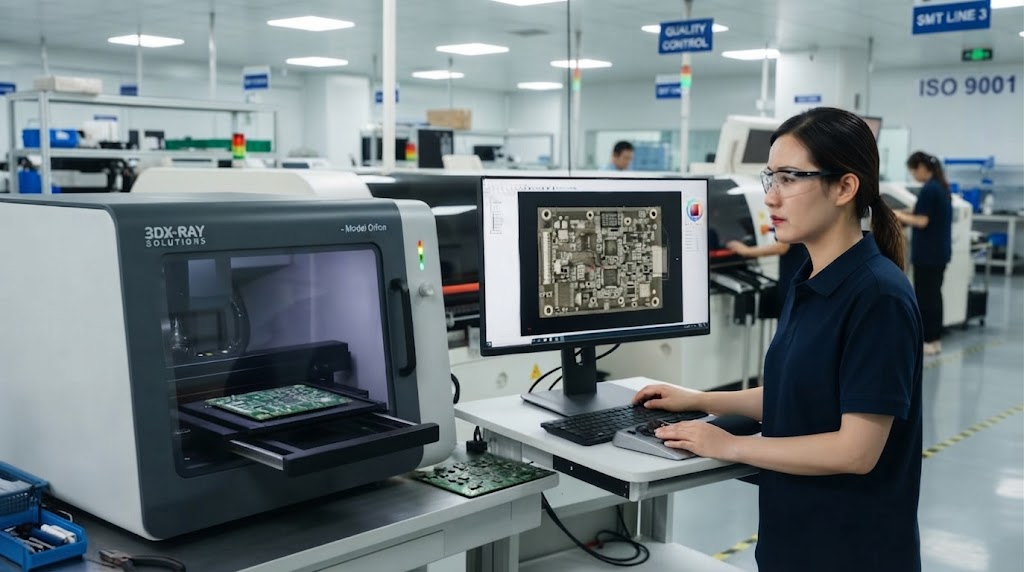
- 3D Automated Optical Inspection (AOI): Real-time telecentric 3D height mapping checks solder fillets, polarity, component shift, and lifted leads down to 0201 (metric 0603) packages.
- 3D Automated X-ray Inspection (AXI): Multi-angle computerized laminography measures void percentages and detects micro-bridging beneath BGAs, LGAs, and bottom-pad power MOSFETs.
- In-Circuit Testing (ICT) & Flying Probe: Parametric verification of individual resistance, capacitance, diode junctions, and board shorts/opens.
- Custom Functional Testing (FCT): Turnkey execution using custom functional testing fixtures that simulate operating conditions, signal inputs, bus communications, and real-time sensor responses.
- Environmental Stress Screening (ESS) & Burn-In: Thermal cycling (-40°C to +85°C) and power-on burn-in testing identify infant mortality issues prior to final integration.
Diverse Medical Device Application Sectors
Our ISO 13485 manufacturing lines produce circuit assemblies across multiple MedTech and clinical sectors:- In-Vitro Diagnostics (IVD): High-density processing boards for automated hematology analyzers, PCR thermal cyclers, and point-of-care test platforms.
- Patient Monitoring Systems: Low-noise analog sensor boards for multiparameter bedside monitors, ECG telemetry, and pulse oximetry units.
- Surgical Robotics & Precision Tools: Multi-layer rigid-flex PCBAs engineered for high vibration resistance in minimally invasive robotic arm actuators.
- Wearable Medical Biosensors: Ultra-miniaturized, flex-based circuitry optimized for continuous glucose monitors (CGM) and wearable cardiac patches.
- Portable Emergency Care Devices: High-power, ruggedized PCB assemblies for automated external defibrillators (AED), field ventilators, and infusion pumps.
Turnkey Medical PCBA RFQ & Manufacturing Checklist
Prior to submitting your medical manufacturing package, use this checklist to ensure all regulatory, testing, and component procurement requirements are complete.- Production Gerber / ODB++ Files: Clean CAD exports detailing copper layers, drill files, solder masks, and silkscreens.
- Structured Bill of Materials (BOM): Explicit manufacturer part numbers (MPN), approved alternate sources, line item designators, and package references.
- Medical Quality Standard Specification: Clear designation of IPC-A-610 Class 2 or Class 3 acceptance criteria.
- Device History Record (DHR) Requirements: Explicit instructions regarding serial number formats, barcode styles, and required archiving periods.
- Testing & Firmware Flashing Guides: Detailed instructions for In-Circuit Test configurations, programming fixtures, and functional test pass/fail limits.
- Regulatory Documentation Mandates: Requirements for Material Declarations (RoHS, REACH), Certificates of Conformance, and special sterilization prep.
Frequently Asked Questions (FAQ)
What is the primary difference between standard PCBA and ISO 13485 certified PCBA?
ISO 13485 PCBA production enforces validated manufacturing processes (IQ/OQ/PQ), complete lot-level component traceability, calibrated environmental controls (ESD and cleanroom metrics), formal risk management (ISO 14971), and auditable Device History Records (DHR) for every produced assembly.Why is IPC-A-610 Class 3 mandatory for life-critical medical devices?
IPC-A-610 Class 3 requires strict criteria for solder joint geometry, barrel fill (>75%), and minimal component misalignment. This standard ensures uninterrupted operational reliability in environments where equipment downtime or malfunction is not an option.How does Visianda EMS support customer FDA audits?
We maintain comprehensive electronic Device History Records, calibration records, material certificates of conformance, and process validation documents. These are organized for immediate access during regulatory audits under FDA 21 CFR Part 820.What is the turnaround time for medical prototype PCB assemblies?
Quick-turn medical prototypes can be assembled in as little as 24 to 72 hours once components are on hand. We maintain dedicated NPI (New Product Introduction) lines to run design validation builds without disrupting volume production.Build Your Life-Critical Medical Hardware with Confidence
Partner with an ISO 13485:2016 certified EMS provider that understands regulatory compliance, rigorous process validation, and zero-defect quality control.
Request a Secure Medical RFQ