
Hermetic vs Quasi-Hermetic Protection: Material Science Foundations
Hermetic sealing for harsh-environment electronics requires creating an impermeable physical barrier using metals, ceramics, or glass-to-metal seals that maintains an internal atmospheric leak rate lower than 1×10⁻⁸ atm·cc/s He. Unlike polymeric encapsulation, true hermetic packaging completely prevents moisture vapor transmission, atmospheric gases, and ionic contaminants from degrading active silicon and high-density interconnects over multi-decade operational lifetimes. In harsh deployment environments—ranging from deep-sea sensors and sub-surface energy exploration to flight-critical avionics—design teams frequently debate between polymer potting and true hermetic enclosures. Polymeric materials such as silicones, polyurethanes, epoxies, and parylene conformal coatings offer moisture delay, not moisture elimination. All polymers possess an inherent Moisture Vapor Transmission Rate (MVTR). Water molecules inevitably permeate polymer chains over days, months, or operating thermal cycles, creating latent corrosion and dendritic growth under sustained electrical bias.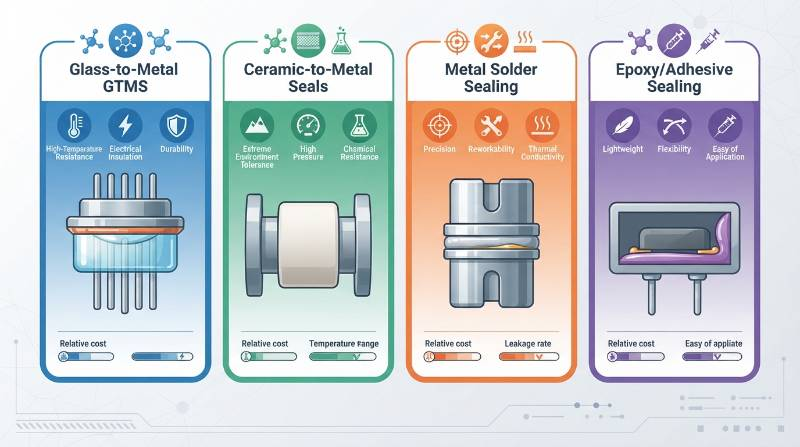
| Barrier Class | Typical Materials | Permeability Rate (g/m²·day) | Hermetic Classification |
|---|---|---|---|
| Polymer Potting / Urethane | Polyurethane, Silicone, Epoxy | 1.0 to 10.0 | Non-Hermetic (Quasi-Protective) |
| Parylene C Coating | Poly-para-xylylene | 0.08 to 0.25 | Non-Hermetic (High Moisture Delay) |
| Glass-to-Metal Seal (GTMS) | Borosilicate Glass + Kovar (ASTM F15) | < 10−9 | True Hermetic (Inorganic Barrier) |
| Ceramic Multi-Layer | Alumina (Al&sub2;O&sub3;), Aluminum Nitride (AlN) | < 10−11 | True Hermetic (Ultra-High Vacuum) |
| Metallic Welded Can | Kovar, Titanium Grade 5, Stainless 316L | < 10−12 | True Hermetic (Atomic Barrier) |
Hermetic Enclosure Technologies: Materials, Laser Welding, and Seam Sealing
Achieving a reliable hermetic cavity depends on matching the housing materials and applying the correct perimeter joining process. A coefficient of thermal expansion (CTE) mismatch between the header, package lid, and feedthroughs generates microscopic fracture paths during thermal cycling.Package Metallurgies and CTE Matching
The standard alloy for hermetic packages is Kovar (UNS K94610 / ASTM F15), an iron-nickel-cobalt alloy engineered to match the thermal expansion curve of borosilicate sealing glass (~5.5 × 10⁻⁶/°C from 25°C to 450°C). For weight-sensitive airborne payloads, high-strength titanium alloys (Ti-6Al-4V) or explosion-bonded aluminum-silicon matrix composites serve as lightweight alternatives, paired with custom laser-welded feedthroughs.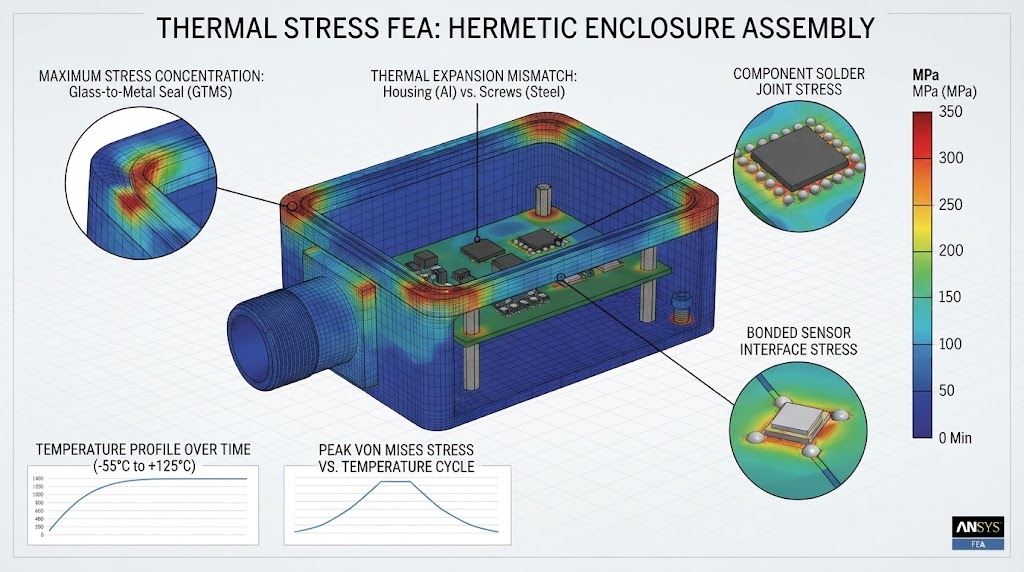
Laser Welding vs. Parallel Resistance Seam Sealing
Closing the cavity without subjecting sensitive internal components to excessive thermal stress requires precision sealing technologies:- Parallel Resistance Seam Sealing: Employs two rolling electrode wheels passing high AC/DC pulses along the perimeter of a stepped Kovar lid. Heat is restricted locally to the lid-package interface (~100 μm zone), keeping the internal circuit die temperature below 85°C.
- Pulsed Nd:YAG / Fiber Laser Welding: Delivers high-density photon energy in microsecond pulses with tight spot sizes (50 to 150 μm). It supports complex non-rectangular geometry sealing in titanium, aluminum, and stainless steel housings with minimal heat-affected zones (HAZ).
Engineering Insight: During laser or resistance sealing, the internal package temperature must not exceed the solidus point of internal solder alloys (e.g., 217°C for SAC305 or 280°C for Au80Sn20). At Visianda EMS, embedded micro-thermocouple probes verify that internal cavity temperatures remain below 100°C throughout the sealing cycle.
Turnkey SMT Assembly DFM for Cavity-Sealed Electronics
Assembling electronics slated for hermetic sealing requires strict contamination control and design-for-manufacturing (DFM) discipline. Any volatile organic compounds (VOCs) or moisture trapped on the board before sealing will desorb inside the enclosure, causing internal corrosion or vapor clouding.Outgassing Elimination and Cleanliness
Standard FR-4 laminates can absorb up to 0.20% to 0.50% moisture by weight. In cavity-sealed electronics, designers often replace FR-4 with non-hygroscopic substrates such as low-loss ceramic (HTCC/LTCC), high-Tg polyimide, or Rogers hydrocarbon-ceramic laminates. Manufacturing high-density designs demands precision SMT assembly processes using ultra-low-residue no-clean or water-washable flux systems, followed by automated in-line ionic contamination extraction testing to confirm residues stay below 0.1 μg/cm² NaCl equivalent.Void-Free Vacuum Soldering
Trapped gas pockets in solder joints expand under sub-atmospheric conditions, causing joint failure or solder ball ejection. Utilizing vacuum vapor phase soldering reduces solder voiding below 5% (far exceeding IPC-A-610 Class 3 requirements of ≤ 15%), providing stable thermal dissipation and mechanical strength inside the sealed cavity.The Visianda EMS Hermetic Reliability Integration Matrix (HRIM)
To eliminate reliability gaps between SMT fabrication and final lid hermetic closure, Visianda EMS engineers adhere to a proprietary, four-phase manufacturing framework: The Hermetic Reliability Integration Matrix (HRIM).
| Phase | Process Focus | Engineering Action & Control Thresholds |
|---|---|---|
| Phase 1 | Contamination & VOC Mitigation | Class 10,000 (ISO 7) cleanroom assembly, automated aqueous wash, ultrasonic solvent clean, IPC ROSE cleanliness < 0.1 μg/cm² NaCl eq. |
| Phase 2 | Vacuum Outgas & Controlled Purge | 125°C to 150°C vacuum bakeout at 10−5 mbar for 16–24 hours; transfer into an automated dry glovebox matrix backfilled with 90% N&sub2; / 10% He at < 5 ppm H&sub2;O. |
| Phase 3 | Micro-Welding & In-Line Leak Detection | Parallel seam sealing or pulsed Nd:YAG hermetic welding followed by 100% fine leak Helium Mass Spectrometry + Gross Leak Bubble testing. |
| Phase 4 | Environmental Stress Screening (ESS) | Thermal shock (−65°C to +150°C), HASS mechanical vibration screening, and destructive Internal Vapor Analysis (IVA) validation per batch. |
Standardized Hermeticity Testing Protocols: Fine and Gross Leak Detection
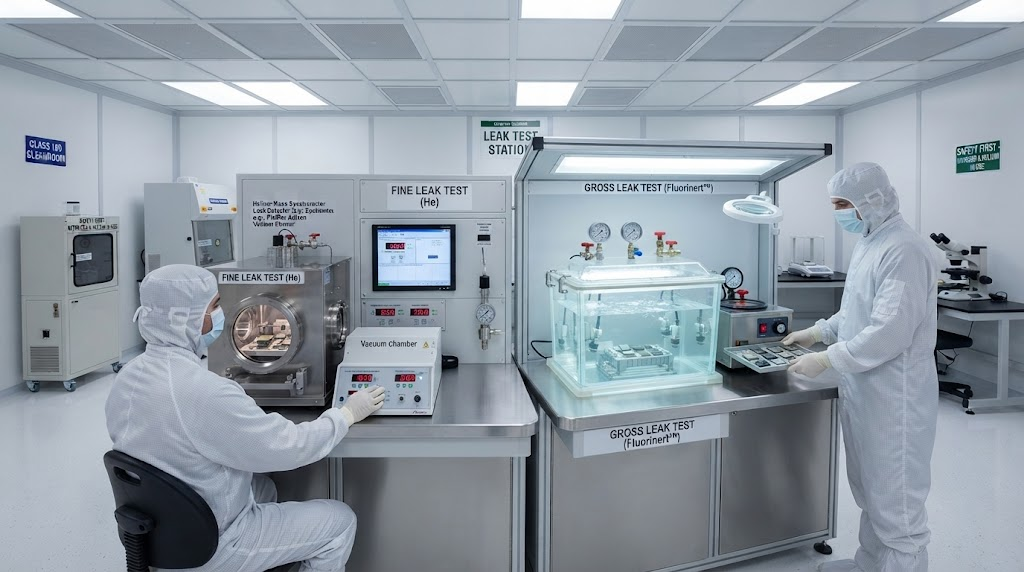
Hermetic verification requires a dual-stage test protocol. Fine leak testing detects microscopic channel defects, while gross leak testing identifies macro cracks where helium escapes before measurement can occur.MIL-STD-883 Method 1014 Fine Leak Testing
Helium mass spectrometry leak detection (HMSLD) is the benchmark standard for fine leak identification per MIL-STD-883 Method 1014 (Condition A) and MIL-STD-202 Method 112. The package is placed in a pressure vessel ("bombing chamber") and pressurized with pure helium gas. The relationship between the measured leak rate ($R_1$) and the actual equivalent standard leak rate ($L$) is governed by the Howl-Mann equation:Howl-Mann Leak Equation: $$R_1 = \frac{L \cdot P_E}{P_0} \left( \frac{M_A}{M} \right)^{1/2} \left[ 1 - e^{-\left(\frac{L \cdot t_1}{V \cdot P_0} \sqrt{\frac{M_A}{M}}\right)} \right] e^{-\left(\frac{L \cdot t_2}{V \cdot P_0} \sqrt{\frac{M_A}{M}}\right)}$$ Where: $P_E$ is bombing pressure, $P_0$ is atmospheric pressure, $t_1$ is bombing duration, $t_2$ is dwell time before spectrometry, $V$ is internal cavity volume (cm³), and $M$ is helium molecular weight.
Gross Leak Detection Techniques
Fine leak detectors can register false passes on packages with large cracks because the tracer gas vents before the vacuum cycle starts. Gross leak testing safeguards against this:- Fluorocarbon Gross Leak Bubble Test (Condition C): Submerges the unit in a heated bath of fluorochemical detector fluid (FC-40/FC-72) at 125°C ± 5°C. Internal gas expansion forms visible bubble streams from housing leaks.
- Optical Laser Interferometry / Deflection: Measures sub-micron lid deflection changes under differential vacuum to confirm structural seal integrity without chemical immersion.
Accelerated Moisture Resistance & Environmental Qualification
Electronic systems operating in rugged automotive electronics manufacturing, engine bays, and subsea pipelines encounter extreme thermal fluctuations coupled with high external moisture. Standard qualification requires rigorous accelerated stress tests.HAST (Highly Accelerated Temperature/Humidity Stress Test)
Conducted according to JEDEC JESD22-A110, HAST exposes assemblies to 130°C and 85% Relative Humidity under 33.3 psia vapor pressure with continuous DC bias. A standard 96-hour HAST run simulates 1,000 hours of conventional 85°C/85% RH (THB) stress, rapidly revealing package corrosion and seal degradation.Internal Vapor Analysis (IVA) & Condensation Control
Internal Vapor Analysis (per MIL-STD-883 Method 1018) pierces the hermetic package within an ultra-high-vacuum mass spectrometer chamber to measure gas concentrations. Crucially, internal moisture must remain below 5,000 ppmv (≤ 0.5%) at 100°C. This guarantees that internal moisture will not condense into liquid water when the device operates at sub-zero temperatures (−40°C to −55°C).Mission-Critical Applications: Aerospace, Defense, and Medical Implants
Reliable moisture barriers and hermetic seals protect critical systems across extreme operational domains:Aerospace and Orbital Spacecraft
Near-vacuum space conditions cause rapid outgassing of organic plasticizers, contaminating optical mirrors and RF wave cavities. Sealing mission-critical avionics in accordance with the IPC-J-STD-001 Space Addendum prevents outgassing and prevents tin whisker growth in pure tin finishes.Class III Active Implantable Medical Devices
Cochlear implants, pacemakers, and neurostimulators run continuously in saline fluids containing sodium and chloride ions at 37°C. In high-reliability medical electronics assembly, biocompatible Grade 5 Titanium enclosures with laser-welded platinum-iridium feedthroughs prevent biological fluids from contacting internal microelectronics over 20- to 30-year operational horizons.EMS Quality Audit Checklist: Verifying Manufacturing & Sealing Capabilities
Prior to signing off on NPI production or volume purchase agreements for hermetically sealed assemblies, verify that your EMS partner meets these core manufacturing criteria:| Verification Area | Critical Audit Requirement | Standard Reference |
|---|---|---|
| Cleanroom Enclosure | ISO 7 (Class 10,000) or ISO 6 sealing environment with positive pressure controls. | ISO 14644-1 |
| Bakeout Chambers | Multi-stage vacuum ovens capable of ≤ 10−5 mbar and temperatures up to 200°C. | Internal SOP / MIL-STD-883 |
| Purge Environment | Closed-loop Glovebox containing ultra-dry Nitrogen (< 5 ppm H&sub2;O, < 5 ppm O&sub2;). | MIL-STD-883 M1018 |
| Fine Leak Testing | Calibrated Helium Mass Spectrometer with daily calibrated leak artifacts. | MIL-STD-883 M1014 Cond A |
| Gross Leak Testing | Fluorocarbon immersion system with temperature stabilization at 125°C ± 5°C. | MIL-STD-883 M1014 Cond C |
| Quality Certification | Certified AS9100D, ISO 13485:2016, and IPC-A-610 Class 3 Master Instructors on site. | Third-Party Audit Certificates |