
Post-Delivery Defect Liability: Defining Terms, Latency, and Contractual Thresholds
Managing post-delivery defect liability, warranty claims, and rma logistics for offshore assembly requires strict contractual boundaries, technical root cause isolation, and duty-free reverse supply chains. Offshore assembly defect liability and RMA logistics govern how original equipment manufacturers (OEMs) and electronics manufacturing services (EMS) providers apportion technical accountability and financial restitution when printed circuit board assemblies (PCBAs) fail post-acceptance. In global electronics manufacturing, ambiguous contracts cause severe operational friction when early-life product failures occur in field deployment. A standard manufacturing agreement must delineate the Defect Liability Period (DLP)—typically spanning 12 to 36 months—while separating immediate functional defects from latent physical anomalies.
- Intermetallic Compound (IMC) Overgrowth: Brittle solder joints prone to micro-cracking under vibrational stress.
- Head-in-Pillow (HiP) Defects: Incomplete metallurgical coalescing at Ball Grid Array (BGA) spheres that creates intermittent opens under thermal expansion.
- Electrochemical Migration (ECM): Dendritic growth across tightly pitched conductors driven by ionic contamination and operating voltage.
- Tin Whiskers: Spontaneous monocrystalline metal eruptions from lead-free pure tin platings causing catastrophic short circuits.
The Tripartite Liability Demarcation Matrix: Workmanship, Components, and Design
Determining financial and operational responsibility for field-returned PCBAs requires an objective technical classification framework. Defect liability falls into three distinct categories: assembly workmanship, component integrity, or product design/DFM.| Defect Category | Typical Failure Modes | Assigned Liability | Commercial Remediation |
|---|---|---|---|
| SMT Workmanship | Solder bridging, cold joints, tombstoning, misaligned ICs, insufficient wetting, ESD degradation. | EMS Provider | 100% rework/replacement cost, reverse freight, customs duties, failure analysis fees. |
| Component Defects | Internal silicon delamination, wafer fab anomalies, counterfeit lot infusion, out-of-spec passive tolerance drift. | Component Distributor / OEM Pass-Through | Distributor warranty recovery. EMS reimburses assembly labor if EMS sourced components under full turnkey terms. |
| OEM Design & DFM | Insufficient thermal relief, layout-induced mechanical stress fractures, overdriven power traces, violating keep-out zones. | OEM / Hardware Team | OEM absorbs all shipping, diagnosis, and replacement costs. Engineering change order (ECO) triggered. |
Handling the "No Fault Found" (NFF) Scenario
A persistent point of friction in offshore returns is the "No Fault Found" (NFF) or "Could Not Duplicate" (CND) outcome. Fielded units returned under warranty that pass standard bench diagnostics consume significant engineering and logistics resources without resolving the underlying issue.Standard Operating Protocol: When NFF rates exceed 0.5% of total shipped lots, units undergo extended Environmental Stress Screening (ESS), including 48-hour thermal cycling (-40°C to +85°C) and multi-axis random vibration testing. If the unit remains fully functional, testing and reverse logistics costs transfer to the party initiating the RMA.
IPC Standards Alignment: Adjudicating Class 2 vs. Class 3 Post-Delivery Disputes
Subjective assessments cannot settle PCBA warranty disputes. Objective defect adjudication requires alignment with internationally recognized standards from the Association Connecting Electronics Industries (IPC), specifically IPC-A-610 ("Acceptability of Electronic Assemblies") and IPC J-STD-001 ("Requirements for Soldered Electrical and Electronic Assemblies").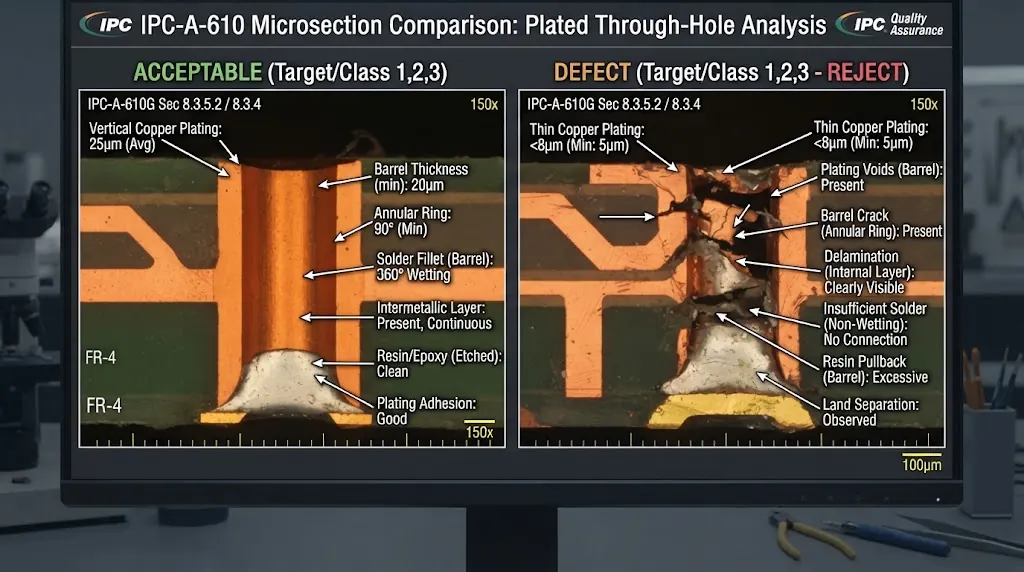
- IPC Class 2 (Dedicated Service Electronic Products): Allows minor cosmetic variations and partial solder fillet reduction where sustained high reliability is desired, but uninterrupted service is not critical. Common in consumer and light commercial systems.
- IPC Class 3 (High-Performance/Harsh Environment Electronic Products): Mandates zero downtime tolerance. Used extensively for mission-critical automotive PCBA manufacturing and ISO 13485 certified medical electronics assembly. Demands stringent barrel fill (>75% vertical fill for through-holes) and strict BGA voiding thresholds (<15% total area).
Warranty Claim Protocols and Advanced Root Cause Failure Analysis
Submitting an offshore warranty claim requires more than sending photos of a non-functioning assembly. Hardware teams and EMS quality engineering groups must execute an Eight Disciplines (8D) Problem Solving Methodology supported by destructive and non-destructive physical failure analysis.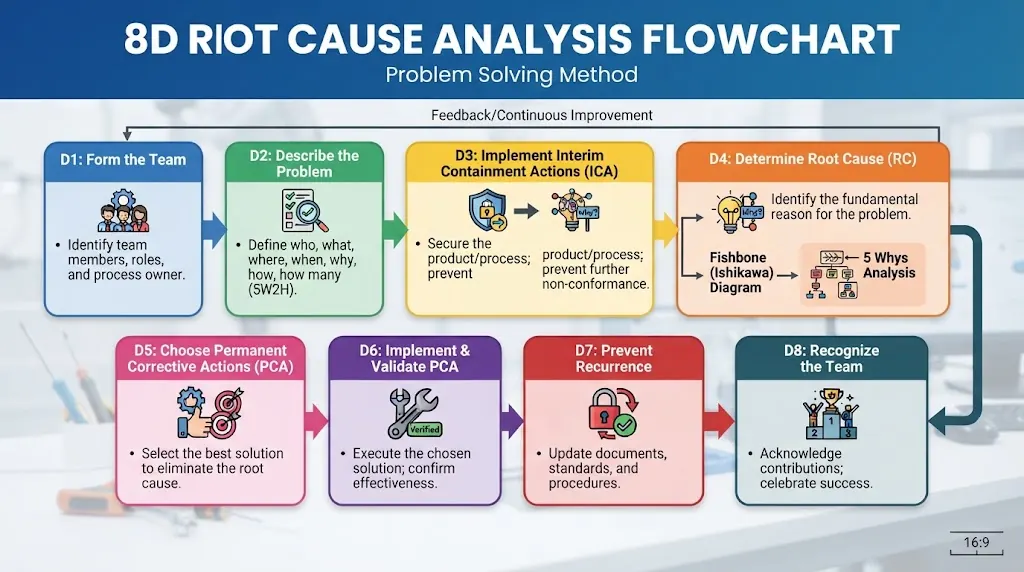
The 8D Corrective and Preventive Action (CAPA) Workflow
- D1 (Form Team): Establish a cross-functional team across the OEM and EMS quality assurance divisions.
- D2 (Problem Description): Quantify the failure mode, affected lot numbers, serial ranges, and operational environments.
- D3 (Containment Plan): Quarantine existing inventory at distribution centers and pause downstream production lines.
- D4 (Root Cause Analysis): Identify the physical mechanism of failure using laboratory diagnostic tools.
- D5 (Corrective Actions): Validate permanent process modifications to eliminate the identified root cause.
- D6 (Implement Corrective Actions): Update SMT parameters, reflow profiles, or pick-and-place placement recipes.
- D7 (Prevent Recurrence): Revise Process Failure Mode and Effects Analysis (PFMEA) and control plans.
- D8 (Team Recognition): Sign off on commercial restitution and close the formal quality ticket.
Physical Failure Analysis Diagnostics
Isolating assembly defects from component internal anomalies requires advanced laboratory inspection:- 3D Industrial Computed Tomography (CT) / X-Ray: Non-destructively identifies internal voiding, solder bridging under opaque packages, and micro-cracking across package ball grids.
- Micro-Sectioning (Cross-Sectional Metrology): Destructively polishes solder joints to inspect intermetallic layer thickness (optimal: 1 to 3 µm) and identify brittle phosphorus-rich nickel layers ("black pad").
- Scanning Electron Microscopy with Energy Dispersive X-Ray Spectroscopy (SEM-EDX): Evaluates elemental composition at the microscopic level to detect chlorine, sulfur, or bromine contamination causing dendritic shorting.
The Visianda Closed-Loop RMA & Liability Adjudication Protocol (CLR-LAP)
To eliminate cross-border disputes and prevent supply chain disruption, Visianda EMS applies a structured 5-phase framework: The Closed-Loop RMA & Liability Adjudication Protocol (CLR-LAP).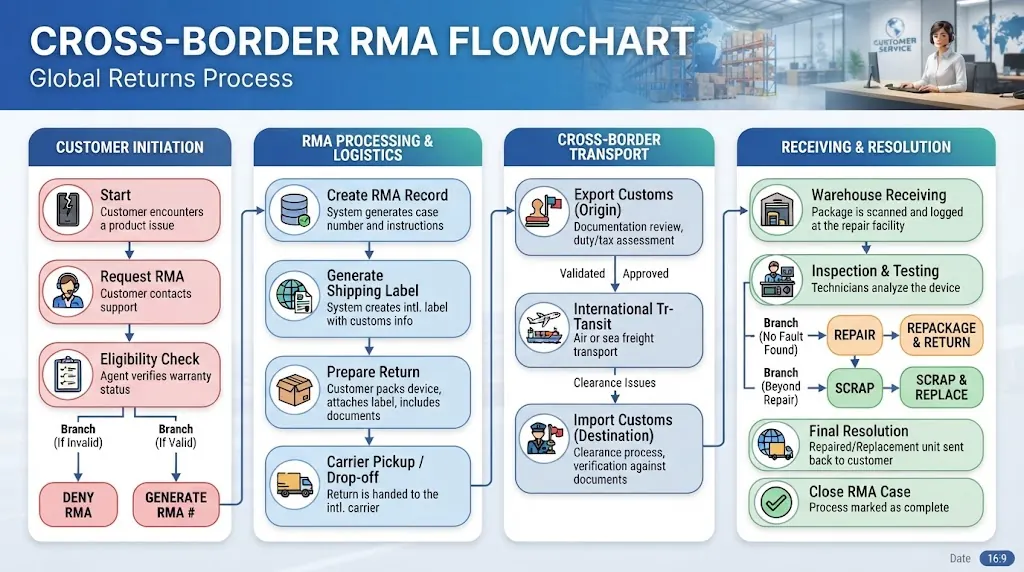
The Five Phases of CLR-LAP
- Phase 1: Digital Intake and Triage ScreeningThe OEM submits digital failure logs, serial tracking records, and high-resolution optical captures through the Visianda Quality Portal within 48 hours of field failure discovery.
- Phase 2: Fast-Track Advance Replacement DispatchTo maintain OEM customer SLAs, replacement assemblies ship immediately from a localized revolving buffer stock before the returned units undergo physical tear-down.
- Phase 3: Non-Destructive to Destructive Tripartite RCAThe returned lot undergoes 3D CT X-ray scanning, electrical curve tracing, and micro-section analysis to determine failure attribution across the tripartite matrix.
- Phase 4: Liability Apportionment & Commercial SettlementCosts are apportioned based on empirical 8D findings. If SMT workmanship is at fault, Visianda issues immediate commercial credit notes covering unit costs, shipping, and customs fees.
- Phase 5: Process Hardening & PFMEA RevisionEngineering modifications are integrated directly into the production line's Automated Optical Inspection (AOI) algorithms and Surface Mount Technology (SMT) thermal profiles to prevent systemic recurrence.
Global Reverse Logistics: Customs Optimization and HTS Duty Relief
International reverse logistics often incur unexpected customs tariffs, value-added taxes (VAT), and regulatory delays when returned goods are improperly declared during cross-border transit. Shipping defective PCBA units back to offshore manufacturing hubs without standard trade declarations risks treating the shipment as a new import, triggering full duty rates on goods already taxed upon original export. Every cross-border RMA shipment must include clear documentation: commercial invoices marked "Defective Goods Returned for Failure Analysis and Warranty Repair Under RMA #[Number] - No Commercial Value - Value for Customs Purposes Only" alongside the original export Bill of Lading.SLA Optimization: Buffer Stock Strategies vs. Rework Turnaround Time (TAT)
Relying solely on return-to-factory rework creates significant operational latency. The average cross-border turnaround time (TAT)—encompassing sea/air transit, customs clearance, 8D laboratory diagnosis, component de-soldering, and re-testing—averages 45 to 75 business days. To avoid supply chain disruption during this latency window, hardware procurement teams utilize two primary warranty fulfillment strategies:- Standard Return & Repair (TAT Model): The OEM returns defective units, waits for factory diagnosis and rework, and receives the repaired PCBA back. While minimizing finished-goods inventory costs, it exposes end customers to extended fulfillment delays.
- Service Revolver Buffer Stock (Advance Replacement Model): The EMS holds an active, pre-tested buffer stock (typically 2% to 5% of annual volume) in a bonded warehouse near the customer's primary distribution hub. When an RMA is logged, replacement units dispatch within 24–48 hours while the failed lot is aggregated for batch failure analysis.
Frequently Asked Questions About Offshore PCBA Defect Liability & RMA
What is the standard Defect Liability Period (DLP) for offshore PCBA?
The standard baseline Defect Liability Period across consumer electronics is 12 months from the date of factory shipment or acceptance. For medical, aerospace, and automotive assemblies, MSAs commonly specify DLPs ranging from 24 to 60 months, aligned with ISO 13485 and IATF 16949 product liability guidelines.Who pays for reverse logistics freight on verified workmanship defects?
Under standard Incoterms rules and IPC manufacturing contracts, the EMS provider covers 100% of reverse freight, import/export duties, and re-delivery costs if failure analysis confirms SMT workmanship non-conformance. If the defect results from design flaws, unapproved operating environments, or passes as No Fault Found (NFF), the OEM absorbs the logistics expenses.How do electronics manufacturers handle latent defects discovered after DLP expiration?
Latent defects stemming from gross negligence or intentional omission of specified manufacturing controls (e.g., omitting required conformal coating or supplying counterfeit silicon) remain actionable under commercial law past the standard DLP. Technical teams must prove the root cause existed during assembly via cross-sectional micro-analysis and lot traceability records.What minimum documentation is required to initiate a high-priority RMA?
A complete RMA initiation package must include: unique PCBA serial numbers, assembly part numbers, complete functional failure logs, visual/X-ray captures of the fault (if available), operational operating conditions (ambient temperature, voltage, duty cycle), and the original purchase order (PO) reference number.Build High-Reliability Hardware with Guaranteed Quality SLAs
Eliminate offshore defect risks with transparent IPC Class 3 quality control, automated 3D X-ray inspection, and streamlined reverse logistics support.
Get a Quality Consultation